One Entity, Many Bullets: Fitting a Projectile Pool Into the ECS
Introduction
The previous article on this blog was about the static, no-heap Entity Component System framer-engine runs on GBA and NDS: a fixed table of component slots and a fixed table of entities, sized to fit in a machine with no malloc(). That fixed sizing has a consequence the article didn't need to dwell on at the time: with today's component set, the table has room for 64 real entities. A caravan-style vertical shoot-'em-up, the first playable milestone this engine is building toward, wants several hundred bullets on screen during a dense pattern. Neither number moves to meet the other — the entity table isn't growing to fit a bullet count, and a bullet pattern isn't capping itself at 64 shots to fit the table.
Note
framer-engine is a personal side project. The source code will be made publicly available once the engine reaches a sufficient level of maturity.
The tension is old and the usual answer is old too: don't make every bullet an entity. What took two attempts wasn't the bullet simulation itself — a flat array of structs, advanced by one system, is not a hard problem — it was deciding how that array gets drawn without quietly opening a second, ECS-shaped hole in the renderer. The first answer shipped, worked, and was wrong in a way no test had a reason to catch. The second answer was smaller, matched a pattern the engine already had, and went on to surface three real bugs across three different rendering backends, none of which were about bullets at all.
The first answer: a queue that isn't an entity
The obvious shape for "hundreds of short-lived things, updated every frame, drawn every frame, never touched individually by name" is a per-frame queue: a flat array of draw commands (position, sprite, frame), reset at the start of each frame, appended to by whatever wants something drawn, and consumed once by the renderer at the end of it. A bullet pool fits that shape exactly — push one entry per live bullet, once, after the physics step — and it required nothing new from the ECS at all, since nothing about it touched an entity, a component, or a query.
That was also exactly the problem. Every other thing this engine draws — a sprite, a tilemap, a HUD label — is an entity carrying a component, and every renderer's draw phase is systems iterating queries. A queue fed directly by application code and drained directly by the renderer is a second path with none of that: it isn't visible to the entity-inspection API a previous milestone added, it isn't something a capability query knows exists, and it isn't something any of the debugging tooling built around "the ECS is the whole scene" has any way to see. It worked, in the narrow sense that bullets appeared on screen in the right place moving at the right speed. It didn't survive being looked at as architecture: elements without an entity, bypassing the engine's own core model, aren't a smaller version of the real design — they're a different design that happens to render the same pixels.
The second answer: an entity that stands for many
framer-engine already had a component that solves this exact class of problem, for a different feature: a Tilemap is one entity whose component points at a grid the owner keeps, and the renderer draws the whole grid from that one entity every frame. Nothing about "many drawn things, one piece of external memory, one component pointing at it" is specific to tiles. The rewrite generalizes that shape and gives it a name — SpriteBatch — and the bullet pool becomes one more caller of it instead of a bespoke path of its own:
struct framer_batch_sprite {
    int32_t x, y;       /* center, world units, fixed point */
    uint32_t texture;
    uint8_t frame;
    uint16_t size;       /* drawn size, world units, fixed point */
};

struct sprite_batch {
    const void *first;   /* owner's element array */
    const uint16_t *count; /* owner's live-element count */
    uint16_t stride;      /* bytes between elements */
};
A framer_bullet places its own struct framer_batch_sprite as its first field, so the bullet pool's own storage array is the SpriteBatch's element array — no copy, no second buffer kept in sync. framer_bullet_pool_entity_create() gives the pool's one entity both a BulletPool component, stepped every frame by a physics system, and a SpriteBatch component built from the same array, drawn every frame by the renderer. Every renderer's draw phase still only ever does one thing: iterate a query and draw what it finds. Hundreds of bullets stay out of the 64-slot entity table; nothing draws that isn't reachable from an entity.
That much is a straightforward generalization of an existing pattern, and it's also where the interesting bugs started, because a component that every renderer backend has to independently learn to draw is a component that gives every renderer backend its own chance to get it wrong.
Bug 1 (Vulkan): a guard that was checking the wrong component
Every renderer backend's sprite system is imported once per world, and every one of them has to answer the same small design question: how do you know "once" has already happened? The naive answer, comparing the stored world pointer against the one you were just called with, breaks the moment a different world gets allocated at the same address — which is exactly what every test in this codebase does, tearing a world down and creating a fresh one for the next case. The existing convention across this codebase's renderer imports is therefore to also check that some component the import function itself registers is actually present on the world in front of you, not just that the pointer matches.
The version of this check written for SpriteBatch picked the wrong component to check:
/* Wrong: Sprite is registered by the renderer's own import, before
 * this function ever runs -- it says nothing about whether THIS
 * function has run on this particular world. */
if (s_world == world && FRAMER_COMPONENT_IS_REGISTERED(world, Sprite))
    return;
On a fresh world reusing a previous world's address, Sprite is already registered — by the caller, earlier in the same framer_sprite_system_import() — before this guard is ever reached. The check reports "already set up" on the very first call, every time, and the function returns without ever registering SpriteBatch or its draw system. Sprites drew fine; batches never did.
This one didn't need staring at code to find — it failed exactly where a test already existed to catch it. The new pixel-readback test for SpriteBatch (draw an element, read the pixel back, expect it filled) passed against the software and OpenGL backends and failed against Vulkan specifically, because Vulkan's test suite happened to run a batch test on a world whose address a prior test had already used. Fixing the guard to check the component this function actually registers —
if (s_world == world && FRAMER_COMPONENT_IS_REGISTERED(world, SpriteBatch))
    return;
— was a one-line change once the failing test pointed at exactly which world-reuse case was wrong. The same wrong-component shape was checked for, by inspection, in the OpenGL and software backends before either one had actually failed a test; both had the identical guard, both got the identical fix, and both were then verified rather than assumed fixed.
Bug 2 (OpenGL): reading back a write that hasn't happened yet
The OpenGL backend's default shaders are compiled lazily, the first time anything asks for one, and cached in the world's own Shader singleton component so the next thousand callers don't recompile anything:
const struct shader *shaders = FRAMER_GET(world, FRAMER_ID(Shader), Shader);
if (!shaders) {
    unsigned int sprite = framer_shader_create(...);
    /* ... compile the other three default shaders ... */

    FRAMER_SET(world, FRAMER_ID(Shader), Shader, .sprite_shader = sprite, /* ... */);
    shaders = FRAMER_GET(world, FRAMER_ID(Shader), Shader);
    if (!shaders)
        return 0;
}

switch (type) {
case SHADER_TYPE_SPRITE: return shaders->sprite_shader;
/* ... */
}
This is correct exactly as long as a component write, from the caller's point of view, takes effect immediately. It doesn't, unconditionally: a write issued from inside a running system is staged and only merged once every system scheduled for that step has finished, so a second system in the same step can already see it, but the same call that just made the write cannot read it back synchronously. That's an ordinary property of this ECS, not a bug in it — every other caller of framer_shader_get_default() had always been either the very first mesh or sprite draw of an existing scene, where something upstream (loading a level, spawning a player) had already asked for a shader on some earlier frame, so the singleton already existed by the time this function's fast path ran.
The SpriteBatch draw system is the first thing in a brand-new scene that has nothing upstream of it — no mesh, no plain sprite entity, just a bullet pool's one entity. On that scene's very first frame, its render system is the very first caller of framer_shader_get_default() ever, from inside a system, in a world where nothing has asked before. The write lands; the read-back in the same call finds nothing; the function returns 0; that frame renders every batch element with no shader bound at all. The fix doesn't touch the ECS's timing at all, because there's nothing wrong with it — it stops asking the world to hand back something it was just told, seconds from now, to go store:
struct shader created = {.sprite_shader = sprite, /* ... */};

framer_component_set(world, FRAMER_ID(Shader), FRAMER_ID(Shader), &created);
return shader_of_type(&created, type);
Bug 3 (all three desktop backends): drawn correctly, in the wrong order
The first two bugs were both "nothing drew." The third one was quieter: every bullet drew, at the right position, the right size, the right texture — and the entity that fired them disappeared behind its own bullets the moment enough of them piled up at its position.
SpriteBatch and the ordinary per-entity Sprite draw are two separate systems in the same ECS phase, and nothing had ever said which one goes first. On GBA and NDS this was never a question worth asking, because the hardware answers it structurally: OAM sprites carry an explicit priority value, and entity sprites are deliberately drawn at a higher priority than batch elements, so an entity is in front of a batch by construction, regardless of which system happened to run first that frame. Sampling the actual OAM contents through mGBA's debug stub, mid-run, confirms it — the emitter (the round blue sprite at the center) sits visibly in front of the spiral of bullets it just fired:
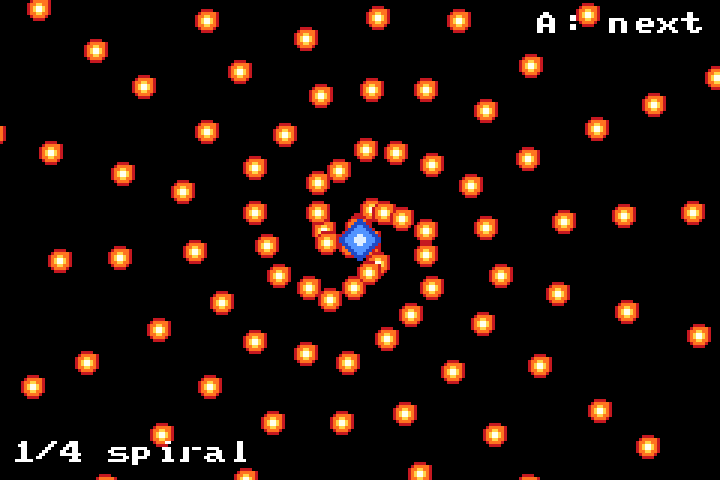
The bullets example's spiral pattern, OAM contents read directly off a running GBA — the emitter draws in front of every bullet it fires, by hardware priority, regardless of draw order.
The three desktop backends (OpenGL, Vulkan, software) have no equivalent hardware guarantee — draw order is the only ordering mechanism they have — and the two systems simply registered in whatever order their import code happened to call them, which put SpriteBatch after the entity sprite system. Sampling actual framebuffer pixels at the emitter's screen position, once every fifty frames of a real Vulkan run, shows exactly the moment it stops working: the emitter's own blue for hundreds of frames, then — once the bullet pool has enough live bullets to reach that exact pixel — the pixel starts reading back as whatever bullet is currently passing through it instead:
frame  350: 2850c8 5a96ff 5a96ff 5a96ff 2850c8   (emitter blue)
frame  750: 2850c8 5a96ff 5a96ff 5a96ff 2850c8   (emitter blue)
frame  800: c81e28 ff7828 ffdc50 ff7828 c81e28   (bullet red/orange)
frame 1200: c81e28 ffdc50 fffff0 ff7828 c81e28   (bullet, still)
The fix is the same one line of intent, spelled out explicitly instead of left to registration order, on every desktop backend:
static const struct framer_system_dep batch_deps[] = {
    {.before = "sprite_render_system", .after = NULL}};

framer_system_register(world, "sprite_batch_render_system",
                        FRAMER_PHASE_ON_UPDATE,
                        sprite_batch_render_system, bq, batch_deps, 1);
A new renderer test pins this down the same way the fix does — a red entity sprite and a white batch element occupying the same pixels, one assertion that the pixel reads back red — so the ordering is now a property the test suite checks rather than an accident of import order.
Verification: one bug per backend, so one check per backend
Nothing about the design change itself is backend-specific, so the actual proof that the redesign works had to be, backend by backend, rather than inferred from any one of them: the desktop pixel-readback tests (software, OpenGL, Vulkan) each got their own pass through the same three scenes, examples/bullets was cross-compiled for both GBA and NDS and the resulting ROM's OAM contents were sampled through mGBA's debug stub — the same technique the previous dithering article used to catch its own hardware-only bug — and every GBA example ROM in the tree was booted headlessly to confirm the pooled component-storage change underneath all of this (a separate, smaller fix the redesign also needed, since one more component pushed the fixed-stride storage layout past EWRAM) didn't regress startup on anything else.
One number came out the same on every target it was checked on, which wasn't the point of the exercise but is a reassuring sign the redesign is actually target-neutral: with the pool's rotating spiral pattern running continuously, the live bullet count settles in roughly the high 90s on GBA, OpenGL and Vulkan alike, all three converging on the same rough capacity for the same pattern despite three completely different drawing paths underneath.
Where this goes next
FRAMER_STATIC_MAX_COMPONENTS (40) and FRAMER_STATIC_MAX_ENTITIES (104, leaving 64 for actual game use) both grew slightly to make room for the new component without pushing the pooled storage past EWRAM on GBA — a two-line configuration change today, in a codebase where each of those numbers has moved before and will again. The bullet-pool roadmap item itself narrows to what's left once "draws correctly, everywhere" is no longer the open question: measuring and documenting the actual per-target bullet ceiling, rather than the two capacity constants (examples/bullets currently uses 128 on GBA/NDS, 1024 on desktop) picked ahead of having real numbers to size them against.