Sixteen Offsets, Two Patterns: Debugging GBA's Ordered-Dither Translucency
Introduction
The two previous GBA articles on this blog — one on cycle-level optimization, one on the no-heap ECS underneath it — were both about working around hardware that has no float unit and no polygon fill. This one is about a narrower, older constraint on the same hardware: the GBA's Mode 4 framebuffer is 8bpp indexed, and its palette is a single, unbuffered, 256-entry table with no double-buffering and no VBlank gating on writes. Reassigning a palette slot recolors every pixel already on screen using that slot, immediately, mid-frame if the timing is unlucky.
That constraint alone rules out the obvious approach — blend per pixel, allocate the blended color a palette slot on the fly — but even without it, real blending wouldn't be affordable here. framer-engine's GBA backend rasterizes 3D faces in software, on a 16.78MHz ARM7TDMI with no hardware alpha unit anywhere in this path: the earlier article on cycle- level optimization on this blog spent its entire length shaving individual cycles off this same rasterizer's inner loop. Blending would mean computing a source/destination color mix and resolving it back to a palette index, for every covered pixel of every translucent face, every frame — real per-pixel work on hardware that has none of it to spare. Dithering sidesteps the cost entirely: the per-pixel decision is a single threshold compare against a precomputed matrix, no blend math and no palette search, so framer-engine answers both constraints the same way plenty of retro-hardware renderers have — translucent 3D faces aren't blended, they're dithered, drawn to roughly the fraction of screen cells their alpha implies, using a fixed Bayer matrix, so the density of drawn pixels approximates the alpha instead of the color itself needing to change.
Note
framer-engine is a personal side project. The source code will be made publicly available once the engine reaches a sufficient level of maturity.
That part worked the first time. What didn't work — twice, in two different ways, both only visible on real hardware — was making more than one overlapping translucent object dither differently enough from its neighbors to stay visible. This article is about both bugs, why the second one is a quieter version of the first one, and why the fix that finally stuck came from building three ROMs and looking at them, not from finding a smarter formula.
The setup: one matrix, one offset per object
The dithering itself is a small, pure function. Given a matrix of threshold values and a per-object "level" (roughly, alpha out of 16), a pixel draws if the matrix value at that screen coordinate is below the level:
static const unsigned char DITHER_BAYER_4X4[4][4] = {
    {0,  8,  2, 10},
    {12, 4, 14,  6},
    {3, 11,  1,  9},
    {15, 7, 13,  5},
};

static inline bool dither_should_draw(int x, int y, int level)
{
    return DITHER_BAYER_4X4[y & 3][x & 3] < level;
}
That's enough for one translucent object. It isn't enough for two. examples/translucent_cubes puts three overlapping cubes — red, green, blue — at the same alpha, drawn back to front. With no per-object variation, every one of them tests the same screen cells against the same level, which means they all draw to the exact same pixels — and since they're drawn back to front, the nearest one simply overwrites the farther ones wherever they overlap, instead of the three visually blending. Each object needs its own dithering phase: something that makes its own draw-set genuinely different from its neighbors', while each individual object still draws the right fraction of pixels.
Bug 1: shifting the coordinate collapses sixteen phases into two
The obvious way to give each object a phase is to shift the sampled coordinate before indexing the matrix — object i looks up BAYER[(y + py) & 3][(x + px) & 3] instead of BAYER[y & 3][x & 3], for some per-object (px, py). Sixteen possible (px, py) pairs, one matrix, sixteen apparently different phases. It shipped, passed its own review, and looked right in the emulator during initial testing.
It did not look right in front of the user's own screenshots. With three overlapping equal-alpha cubes, the middle one — green, sandwiched between red and blue in draw order — was almost entirely invisible everywhere it overlapped blue.

examples/translucent_cubes at the commit that shipped the coordinate-shift phase — green and blue have collapsed into the same draw-set as another object and vanished.
Direct enumeration of all sixteen shifts against the 4x4 matrix at the alpha level in question found the cause immediately: only two distinct draw-sets exist among all sixteen coordinate shifts, not sixteen. The 4x4 Bayer matrix has its own translational symmetry — every shift is equivalent, cell-for-cell, to some other shift of the same parity of (px + py). Two objects landing in the same parity class draw to identical cells, and whichever is nearer in the back-to-front order simply erases the other. Three objects, two available parity classes: one collision was mathematically guaranteed, not a rare edge case.
The fix: rotate the compared value, not the sampled coordinate
The working version doesn't touch the coordinate at all. It rotates the value read out of the matrix by a per-object offset, before comparing it against the level:
static inline bool dither_should_draw(int x, int y, int level,
                                       int offset)
{
    return (int)((DITHER_BAYER_4X4[y & 3][x & 3] + offset) & 15) <
           level;
}
The difference isn't cosmetic. DITHER_BAYER_4X4 is a bijection — every one of its sixteen cells holds a distinct value from 0 to 15. "Which cells have (value + offset) mod 16 < level" selects a level-sized contiguous arc of that value range, and as offset sweeps 0 to 15, the arc's starting point sweeps every residue exactly once. Sixteen offsets, sixteen provably distinct draw-sets, at every level — not empirically distinct for the one alpha value that happened to get tested, but distinct by construction, for the same reason a Caesar cipher with sixteen different shift amounts produces sixteen different ciphertexts of the same plaintext. This shipped, the green cube reappeared, and the next report from real hardware was different in kind: not invisible, just rougher-looking than the other two.
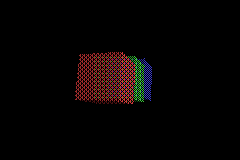
The same demo after the value-rotation fix — all three cubes are visible now, but the thinnest sliver (drawn last, forced onto a worse offset) already reads rougher than its neighbors.
Bug 2: only two offsets out of sixteen are actually smooth
"Rougher" turned out to be exact, not impressionistic. At the alpha level examples/translucent_cubes uses, offset 0 produces a perfect alternating checkerboard:
offset=0                     offset=1
#.#.#.#.                     #.#.#.#.
.#.#.#.#                     .#.#.#.#
#.#.#.#.                     #.#.#.#.
.#.#.#.#                     .#.#.#.#
Only one other offset (8, exactly half the matrix's sixteen values away) produces the other perfect checkerboard, disjoint from offset 0's. Every offset in between is a near-miss: the same pattern with a handful of cells flipped, visibly less regular the farther the offset sits from 0 or 8. Three overlapping objects need three distinct offsets to stay correctly visible — that part was already fixed — but with only two "perfect" offsets available in a 16-value matrix, the third object is mathematically forced onto a visibly irregular one. Not a bug in the value-rotation fix; a structural property of a matrix this small combined with needing three simultaneously-distinct patterns.
A bigger matrix buys a finer gradient, not an exemption
Growing the matrix to 8x8 (64 distinct values instead of 16) doesn't remove the "only two perfect offsets" property — it can't; the argument above doesn't care about matrix size. What it buys is a much finer gradient around those two perfect points, so a third offset near either one looks close to perfect instead of visibly broken. The external contract stayed untouched: callers still pass a level from 0 to 16, unchanged, with the comparison internally rescaled by a factor of 4 to land on the 8x8 matrix's 0-63 range:
static inline bool dither_should_draw(int x, int y, int level,
                                       int offset)
{
    return (int)((DITHER_BAYER_8X8[y & 7][x & 7] + offset) & 63) <
           level * 4;
}
This shipped as a real improvement — the third cube went from "noticeably wrong" to "close to right." It was also, it turned out, not actually fixing the thing that mattered.
The bug the roughness metric couldn't see
The offsets fed to each object weren't picked arbitrarily; they came from a 64-entry table, ranked by how close each individual offset's own pattern was to a perfect checkerboard — offset 0 first, offset 32 (the 8x8 matrix's other perfect point) second, then the next-closest offsets after that. For three simultaneously-visible objects, that table handed out 0, 32, 1.
Offset 1 is, individually, an excellent choice — its own pattern is almost perfectly checkerboarded, one flipped cell out of sixty-four. The ranking wasn't wrong about that. What it never asked is a different question: how much does offset 1's draw-set overlap offset 0's? The answer is 31 of 32 drawn cells, identical. The third object was, once again, drawing to almost exactly the same pixels as the first one — the original bug, wearing a much better disguise, because "individually smooth" and "well separated from your neighbors" turned out to be two different properties the same ranking had been quietly conflating.
Testing three sequences instead of guessing
Fixing the separation problem analytically ran straight into a genuine trade-off, not a formula. Offsets chosen purely to maximize separation from each other — evenly spread around the matrix's 64-value range — land on values like 16 and 48, and those render as perfectly regular vertical or horizontal stripes instead of checkerboard noise:
offset=1 (roughness-ranked)      offset=16 (separation-first)
#.#.#.#.                         #.#.#.#.
.#.#.#.#                         #.#.#.#.
#.#.#.#.                         #.#.#.#.
.#.#.#.#                         #.#.#.#.
#.#.#.#.                         #.#.#.#.
.#.#.#.#                         #.#.#.#.
#.#.#.#.                         #.#.#.#.
#..#.#.#                         #.#.#.#.
The stripe pattern shares only 16 of 32 cells with its neighbors instead of 31 — a real, large improvement by the numbers — but axis-aligned stripes are a textbook example of a dither pattern that's more noticeable than diagonal checkerboard noise, not less, on real display hardware. Whether that trade-off actually looks better than the original near-miss checkerboard isn't something more computation could answer.
So the answer came from building three complete 64-entry offset sequences — the original roughness-ranked table, a separation-maximizing one (a bit-reversal permutation, also known as a Van der Corput sequence: entry i is the 6-bit binary reversal of i, which guarantees every prefix of the sequence is evenly spread around the offset range), and a capped-overlap middle ground — compiling all three into real translucent_cubes.gba ROMs, and testing them in mGBA. The separation-maximizing sequence won, stripes and all.
static const unsigned char GBA_DITHER_OFFSET_SEQUENCE[64] = {
    0,  32, 16, 48, 8,  40, 24, 56, 4,  36, 20, 52, 12, 44, 28, 60,
    2,  34, 18, 50, 10, 42, 26, 58, 6,  38, 22, 54, 14, 46, 30, 62,
    1,  33, 17, 49, 9,  41, 25, 57, 5,  37, 21, 53, 13, 45, 29, 61,
    3,  35, 19, 51, 11, 43, 27, 59, 7,  39, 23, 55, 15, 47, 31, 63,
};
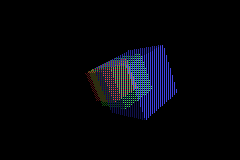
The same demo with the bit-reversal sequence — three distinct, evenly-separated offsets, no object drawing to nearly the same cells as another.
Verifying a change with nothing to count
The GBA performance article on this blog leaned on cycle_probe.py for every claim — a deterministic cycle count, diffed between builds. None of that applies here: this is a pure output-correctness question, not a performance one, and the actual measurable claims are combinatorial rather than empirical. Every mechanism change in this story — the value-rotation fix's sixteen-provably-distinct-draw-sets claim, the 8x8 matrix's exact-count-at-every-level-and-offset property, the bit-reversal sequence's even-prefix-spread property — was verified by direct construction in Python before being written as C: enumerate every offset, every level, every pair, and check the property holds for all of them, not just the one case that happened to get tested by hand. Beyond that: the full desktop test suite, a GBA cross-compile, and a headless mGBA run of examples/translucent_cubes on every change, plus — for the final offset-sequence choice specifically — actually looking at the rendered result, which is the only step in this whole chain that caught the thing the math couldn't.
Where this goes next
The bit-reversal sequence is still one fixed, precomputed table, shared across every scene — it optimizes pairwise separation for a sequence of offsets, not jointly for whichever specific set of objects happens to be simultaneously overlapping in a given frame. For the realistic case this backend actually renders — a small, fixed handful of translucent objects — that's enough. A scene with many more simultaneously-visible translucent objects than any current example has would eventually exhaust the sequence's best-separated entries and reach ones no better than the original bug. Jointly optimizing offset assignment across the actual in-use set, per frame, is the natural next piece if that ever stops being hypothetical — and, going by how this story went twice already, probably has its own hardware surprise waiting inside it.