Squeezing Cycles: Optimizing a Software 3D Renderer for the GBA
Introduction
framer-engine is a small cross-platform ECS game engine I've been building, with backends ranging from desktop OpenGL/Vulkan down to bare software rendering on 8/16-bit consoles. The Game Boy Advance backend renders actual textured/shaded 3D meshes — cubes, cones, spheres — through a CPU-only software rasterizer, on a 16.78MHz ARM7TDMI with no FPU and no hardware polygon fill. Every float operation is a soft-float library call, every divide is a library call, and every pixel is a CPU read-modify-write into VRAM.
Note
framer-engine is a personal side project. The source code will be made publicly available once the engine reaches a sufficient level of maturity.
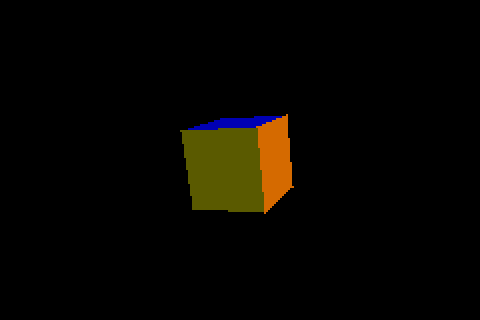
examples/simple_cube, captured straight from mGBA — the demo this article's simple_cube numbers are measured on.
This article is about what it actually takes to make that fast — not in theory, but measured. Every number below comes from scripts/debug/gba/cycle_probe.py, a small script that sets a breakpoint on the engine's vblank-wait function inside headless mGBA and reads the emulator's cycle counter on every hit. mGBA's CPU emulation is deterministic: the same ROM run with the same inputs produces bit-identical cycle counts every time, which means an optimization claim isn't "it looked smoother" — it's "frame N now costs X fewer cycles, every single run." I discard the first ~100 frames as warm-up (caches, branch predictor-equivalent effects, lazy first-frame setup) and average the steady-state window after that.
That discipline matters more than any individual trick below, because twice during this work an optimization that was obviously, mathematically correct measured as a regression. More on that at the end.
The hardware constraint that drives everything
The GBA's display is locked to the LCD's scanout rate. A frame takes exactly 280896 cycles of the system clock to display, whether or not your CPU work fits inside it — if you go over, you just drop to displaying every other frame (or worse), the displayed frame rate quantizing to 59.73 / n for whatever integer multiple of that budget your frame actually costs. There's no "GPU" to defer to and no way to partially miss the deadline gracefully. The entire optimization exercise is: get the CPU-side frame cost under (or as close as possible to) 280896 cycles.
Every technique below exists because of two specific limits:
- No FPU. Any float/double arithmetic — multiply, divide, sqrtf(), sinf()/cosf()/tanf() — compiles to a call into ARM's soft-float runtime. That's not "slower than native float," it's "a function call plus a software algorithm" for every single operation.
- No hardware rasterizer. Mode 4's bitmap layers are just VRAM you write to with the CPU. Every triangle the software renderer fills is pixels the ARM7TDMI itself has to compute and store, one at a time.
Technique 1: fixed-point math instead of float
The most foundational change is also the simplest to state: the hot path (per-vertex transform, per-pixel rasterization) uses Q12 fixed-point integers instead of float, via a small fix_t type (src/backends/renderer/common/sw3d_fixed.h):
typedef int32_t fix_t;

#define FIX_SHIFT 12
#define FIX_ONE   (1 << FIX_SHIFT)   /* 4096 == 1.0 */

static inline fix_t fix_mul(fix_t a, fix_t b)
{
    return (fix_t)(((int64_t)a * (int64_t)b) >> FIX_SHIFT);
}
fix_mul's int64_t intermediate looks like it should be expensive, but on ARM it lowers to a single hardware SMULL (signed multiply, 64-bit result) instruction — no library call, no precision tricks, just the right type for the CPU's native multiply. Compare that to a float * float, which on this target is a soft-float call doing mantissa/exponent bookkeeping in software.
Division is the one place fixed-point still hurts, because there's no hardware divider on the ARM7TDMI either way — fixed-point divide still costs a library call (__aeabi_idivmod et al.), just an integer one instead of a float one. The perspective-divide hot path exploits a narrower fact about that specific division to cut its cost further:
/* fix_div()'s general implementation widens to a 64-bit intermediate to
 * stay correct for arbitrary numerators, but the perspective divide's
 * numerator is always FIX_ONE, so FIX_ONE << FIX_SHIFT never exceeds
 * 32 bits. */
static inline fix_t fix_reciprocal(fix_t b)
{
    return (fix_t)(((int32_t)FIX_ONE << FIX_SHIFT) / b);
}
That one change — replacing the general 64-bit fix_div() with a 32-bit-only reciprocal for the one call site where the numerator is known to always be FIX_ONE — measured a ~50,000 cycle/frame saving on examples/spinning_shapes, just from giving the divide routine a narrower, cheaper problem to solve.
Technique 2: a LUT instead of sinf()/cosf()
framer_transform_get_matrix() (the shared, cross-platform transform code) builds rotation matrices via cglm's glm_rotate_{x,y,z}(), which call cosf()/sinf(). On desktop that's a couple of FPU instructions; on the GBA it's a soft-float libm round trip, once per axis, per object, per frame.

examples/spinning_shapes, captured from mGBA — three objects rotating on all three axes every frame, the demo behind every spinning_shapes number in this article.
The GBA backend instead carries its own 256-entry sine table (sw3d_raster.c), reading cosine from the same table at a quarter-turn offset, with linear interpolation between samples:
static const fix_t gba_sin_lut[256] = { /* ... */ };

static void gba_fast_sincosf(fix_t angle_turns_256, fix_t *s, fix_t *c)
{
    int idx = angle_turns_256 & 0xff;
    int cidx = (idx + 64) & 0xff; /* cos(x) == sin(x + tau/4) */

    *s = gba_sin_lut[idx];
    *c = gba_sin_lut[cidx];
}
256 entries means ~1.4° between samples — far finer than visible on a 240x160 screen, so the linear interpolation error never shows up as visible jitter. Swapping this in for the float sin/cos chain, measured A/B (git stash + identical build/measure commands) on spinning_shapes (which rotates 3 objects on all 3 axes every frame): 1,294,320 → 1,234,341 cycles/frame, a ~4.6% reduction, from removing one class of soft-float call entirely.
A follow-up went further: rather than building the rotation matrix the way cglm does — up to three separate generic 4x4 matrix multiplies, one per nonzero Euler axis, each a 64-multiply-add matmul even though most entries of a pure-axis rotation matrix are 0 or 1 — the combined Rz·Ry·Rx product's 9 nonzero 3x3 entries are expanded by hand from the three angles' sin/cos (still sourced from the LUT above) and folded into the output with a single glm_mat4_mul instead of up to three:
/* out = Rz * Ry * Rx, 9 nonzero entries expanded by hand instead of
 * three generic 4x4 matmuls. */
out[0][0] = cy * cz;
out[0][1] = cy * sz;
out[0][2] = -sy;
out[1][0] = sx * sy * cz - cx * sz;
out[1][1] = sx * sy * sz + cx * cz;
out[1][2] = sx * cy;
out[2][0] = cx * sy * cz + sx * sz;
out[2][1] = cx * sy * sz - sx * cz;
out[2][2] = cx * cy;
This was verified against the original three-matmul path via NumPy differential testing across all 8 zero/nonzero axis combinations plus thousands of random angle triples (max absolute error ~1e-16) before it ever touched the renderer. Measured gain: only 1,309,080 → 1,306,224 cycles/frame, ~0.22% — much smaller than the raw operation count suggests, because the compiler's optimizer already folds away most of the original chain's zero/one multiplies once each Rz/Ry/Rx factor starts from an identity-seeded matrix. The lesson here isn't "this technique didn't matter" — it's that hand-expanding math only pays for itself once you've checked what the compiler was already doing for you. A second, branch-free variant that skipped the matrix multiply altogether (translation column copy + per-column scale) was also tried and measured worse in every iteration than this simpler one-matmul version — discarded in favor of what actually measures faster.
Technique 3: Quake III's fast inverse square root
Triangle shading needs each surviving triangle's world-space normal, normalized — once per shaded triangle, per frame, in the single hottest loop of the renderer. cglm's glm_vec3_normalize() calls sqrtf() and then divides by it: two soft-float library calls per triangle.
The fix is the famous bit-hack:
static float sw3d_fast_inv_sqrt(float number)
{
    union { float f; uint32_t i; } conv = { .f = number };

    conv.i = 0x5f3759df - (conv.i >> 1);
    conv.f *= 1.5f - (0.5f * number * conv.f * conv.f); /* one Newton-Raphson step */
    return conv.f;
}
One magic-constant bit-shift gets a rough inverse-square-root estimate straight from the float's IEEE bit pattern (no sqrt call at all), and one Newton-Raphson correction step sharpens it to be visually indistinguishable from the real thing for lighting purposes. Replacing both the sqrt and the divide with this one function, used at every site in the GBA backend that previously called glm_vec3_normalize() (face-normal lighting in the renderer, and the rasterizer's own triangle-normal centroid computation), removes two soft-float calls per triangle for one cheap integer/float hybrid op.
Technique 4: an ECS dispatch early-out
Not every win is renderer-specific. framer_world_progress(), the ECS scheduler's per-frame loop, walked every registered system's full entity range every frame — including systems whose query needs a component type that no entity in the scene has ever had. simple_cube registers collider/velocity/rigidbody systems unconditionally on every platform (component import is unconditional, regardless of whether the scene actually uses them), so most of those systems were scanning entities every frame only to match zero of them, every single time.
The fix tracks a sticky OR of every component bit ever set across the world's lifetime, and skips a system's scan entirely — O(1), no entity walk at all — whenever its query's required mask includes a bit outside that set, which can provably never match:
/* s_any_mask: sticky OR of every component bit ever set across the
 * world's lifetime. A query whose mask requires a bit outside this set
 * can never match any entity — skip the per-entity scan entirely. */
if ((q->mask & world->s_any_mask) != q->mask)
    continue;
This is the single largest win found across the whole project: simple_cube: 308650 → 288629 cycles/frame; spinning_shapes: 757806 → 744701 cycles/frame (both steady-state averages over frames 101-150). A scheduler-level fix, not a renderer trick, but it followed from the exact same discipline: measure where the cycles actually go, don't assume.
Technique 5: making divides Bresenham-shaped
The scanline rasterizer (sw3d_fill_triangle()/sw3d_fill_quad()) originally tested every pixel inside each triangle's bounding box against all three edge functions to decide if it was inside. The replacement computes each row's [lo, hi] x-span directly per edge, incrementally, which is exactly Bresenham's line algorithm applied to "x as a function of y" along a triangle edge:
/* Incrementally tracks bound(y) = floor((b0 + (y - y0) * d) / a) for a
 * fixed positive `a`, one row at a time, with zero divisions after
 * init. The GBA's ARM7TDMI has no hardware divider, so trading one
 * division per edge (at init) for what used to be a same-sign test on
 * every bounding-box pixel is the whole point. */
struct row_bound {
    long val, step, rem, err, a;
};
This turns "one division-equivalent test per candidate pixel" into "one division per triangle edge, plus an integer add per row" — a meaningful shape change on hardware with no hardware divider at all.
It also produced one of the more unusual micro-optimizations in the codebase. The one division this scheme still needs per edge (floordiv_pos()) is built on a / b and a % b in C, which GCC is supposed to fuse into a single __aeabi_idivmod call when both are needed. Disassembly showed that fusion happening on one branch (a > 0) but not the other (a < 0, which negates both operands first) — an extra, redundant __aeabi_idiv call alongside the __aeabi_idivmod for the same division, confirmed to be a GCC codegen quirk specific to that branch (restructuring the C source produced byte-identical codegen either way, so it wasn't fixable from the C side). The actual fix is to call the library function directly and unpack its packed 64-bit r0:r1 quotient/remainder result by hand, removing the compiler's latitude to make the wrong call-fusion choice at all:
extern long long __aeabi_idivmod(long numerator, long denominator);

static long floordiv_pos(long a, long b)
{
    long long qr = __aeabi_idivmod(a, b);
    long q = (long)(uint32_t)qr;
    long r = (long)(qr >> 32);

    if (r != 0 && a < 0)
        q--; /* C truncates toward zero; floor() needs a -1 correction */
    return q;
}
Saved roughly 25,000-30,000 cycles/frame on spinning_shapes — for removing one redundant library call the compiler was inserting on its own, on one branch only, for no reason a compiler flag could fix.
Technique 6: let the hardware scale a smaller image
The GBA has no hardware polygon fill, full stop — every pixel the rasterizer covers is a CPU read-modify-write into VRAM, which is the hard floor under every other optimization in this list: at some point you've removed every avoidable division and float op, and you're still bound by "how many pixels does the CPU have to touch."
The way around that floor isn't a CPU optimization at all: Mode 4's BG2 background layer supports affine transforms even though it's a flat bitmap — the same trick behind GBA titles that faked SNES Mode-7-style scaling. The renderer draws only a 120x80 corner of the framebuffer (a quarter the pixels of the real 240x160 screen) and lets BG2's affine matrix stretch that corner across the full screen at scanout time, for free, in hardware:
#if GBA_RENDER_SCALE == 1
static inline void gba_clear_buffer(vu16 *base) { /* full-res clear */ }
#else
static inline void gba_clear_buffer(vu16 *base)
{
    /* only clear the GBA_RENDER_WIDTH x GBA_RENDER_HEIGHT corner that's
     * actually sampled by BG2's affine matrix — the rest of the page is
     * never displayed, so clearing it is wasted work. */
}
#endif
On spinning_shapes this dropped steady-state cost from ~1.55M to ~1.28M cycles/frame — roughly 10.8fps → 13.1fps, a ~17% reduction — at the cost of visibly blockier 2x-nearest-neighbor-scaled edges. It's opt-in (-Dgba_half_res) rather than default, because unlike every other technique here it's a genuine, visible quality trade-off rather than a free win — worth calling out, since this whole article is otherwise about zero-visual-cost changes.
The measurement discipline that makes any of this credible
None of the numbers above are estimates. scripts/debug/gba/cycle_probe.py drives headless mGBA, sets a breakpoint on the engine's vblank-wait call (the one point every frame reliably passes through exactly once), and reads the emulator's own cycle counter on every hit. Because mGBA's CPU core is a deterministic interpreter/JIT — not a real, jittery piece of silicon — the same ROM, same breakpoint, same number of warm-up frames discarded, produces bit-identical cycle counts on every run. That turns "did this help?" from a vibes question into a yes/no one: rebuild, re-run the probe, diff the number.
That discipline is also what caught the two times this project tried an "obviously correct" optimization that wasn't.
War story 1: caching screen-space half-extents that never change
The camera's screen-space half-width/half-height, once converted to fixed-point, don't change frame to frame unless the camera's projection changes — so hoisting that fixed-point conversion out of the per-vertex projection loop and caching it looked like a pure, free win: same values, computed once instead of once per vertex.
It measured as a regression.
The likely cause, confirmed by inspecting the generated assembly rather than guessing: this project builds with link-time optimization (LTO) and -Doptimization=3 across the board, and LTO's inlining heuristics are sensitive to function and loop size in ways that aren't intuitive from the C source. Adding a cache check (even a cheap one) to an already-hot, already-inlined loop changed the cost/benefit math the inliner used elsewhere in the same translation unit, and the net effect of removing unrelated, more valuable inlining outweighed the arithmetic actually saved. The "obviously correct" loop-invariant hoist was correct about the math and wrong about the measured outcome.
War story 2: skipping integration work for a zero velocity
The same pattern showed up again, independently, in velocity_integration_system(). Most entities in simple_cube have a Velocity component that's exactly zero every frame — adding a zero-vector early-out before the glm_vec3_scale/glm_vec3_add calls is mathematically a no-op (scaling and adding a zero vector changes nothing), so it looked like free cycles for every entity that wasn't actually moving:
/* tempting, and wrong on this build */
if (glm_vec3_isvalid(v->linear) && glm_vec3_norm2(v->linear) == 0.0f &&
    glm_vec3_norm2(v->angular) == 0.0f)
        continue;
Measured: +112 cycles/frame on simple_cube, +312 on spinning_shapes. A regression, on a change with no behavior difference whatsoever. Same root cause as the screen-extent cache: the early-out added code size and a branch to a hot loop, LTO's inlining decisions shifted in response, and whatever inlining was lost elsewhere cost more than the skip saved. It was reverted in the same session it was tried, per the same rule that caught it: measure before keeping, no exceptions for changes that "can't possibly" make things worse.
The takeaway isn't "don't trust loop-invariant hoisting" or "don't trust early-outs" — both are completely standard, usually-correct techniques. It's that once a build is leaning on LTO and aggressive optimization levels to do a lot of the heavy lifting, the compiler's own decisions become part of the system you're optimizing, and they don't always move in the direction your mental model of the code predicts. The only way to know is the same cycle_probe.py round-trip used for every win in this article: change one thing, measure, keep it only if the number actually goes down.
War story 3: quantizing colors in the wrong number system
The GBA backend's shaded sprites and triangles go through gba_palette_index(): a linear scan (up to 256 entries, with a nearest- color distance calculation once full) that maps a computed RGB555 value onto BG_PALETTE, since Mode 4 is 8bpp paletted, not true color. A one-entry cache short-circuits two consecutive calls requesting the exact same value — but continuous per-frame lighting math (examples/ lighting, added since this article's original techniques, orbits two colored point lights around a static sphere and cube) makes each shaded triangle request a slightly different value almost every frame, defeating that cache and driving the palette to saturation within seconds.
The fix looked obvious: round each lit color channel to a coarser step — 16 buckets instead of RGB555's own 32 — before it ever reaches the palette lookup. A gradually-changing light then collapses onto a much smaller, more repeated set of values: more cache hits, and a palette that stays truer to intent for longer before saturating. The first implementation did this in float space, right where the lit color was already a float:
/* looked free, measured otherwise */
static inline float gba_quantize_channel(float v)
{
    const float steps = 16.0f;
    return (float)(int)(v * steps + 0.5f) * (1.0f / steps);
}
Measured with cycle_probe.py on the same orbiting-lights demo, 150 frames, steady-state average over frames 101-150: 646528 cycles/frame with no quantization at all, versus 658869 with it — a ~1.9% regression, not the improvement it was meant to be.
The cause, once measured rather than assumed: this is still the same FPU-less ARM7TDMI every other technique in this article exists to work around. v * steps + 0.5f, the cast, and * (1.0f / steps) are three more soft-float library calls, paid on every one of the three channels, for every shaded triangle, every frame — and that cost was larger than whatever palette-scan time it was saving. An optimization aimed specifically at this hardware's constraint had itself ignored that same constraint.
The fix moves the rounding into integer space instead, using a value the code already computes. f_to_5bit() (the existing float→RGB555-channel helper) produces a clamped 0-31 integer; masking off its low bit gives 16 buckets — the identical bucket count as the float version — for the cost of one AND on a value that has to be computed either way:
static inline u16 f_to_5bit_quantized(float v)
{
    return (u16)(f_to_5bit(v) & ~1u);
}
Same demo, same steady-state measurement: 642455 cycles/frame — a genuine, if modest, ~0.63% improvement over the no-quantization baseline. The idea behind the optimization was sound; it just had to be expressed in a number system this CPU can actually multiply in for free.
Where this leaves things
After all of the above, examples/simple_cube sits at 288074 cycles/frame — 16777216 / 288074, the same ratio cycle_probe.py itself reports for every measurement in this article — works out to ~58.24fps, against a true-60fps budget of 280896 cycles (~59.73fps). That's about 2.5% over budget, down from a starting point of roughly 7-8% over before this round of work. spinning_shapes — three fully shaded objects rotating on all three axes every frame, a heavier scene by design — sits at 741378 cycles/frame, ~22.63fps. Both are ceilings for these specific demo scenes on real, cycle-accurate emulation, not estimates: add more triangles or lights to either scene and the frame cost (and fps) moves accordingly. Closing the rest of that gap on simple_cube would mean moving into riskier territory: caching ECS query results across frames (not just the existence-of-any-entity check from Technique 4), or pre-converting mesh vertex data to fixed-point ahead of time instead of per-vertex at raster time — the latter complicated by the fact that the same mesh struct is also populated through framer-engine's public, float-only custom-mesh API, so caching it would mean either changing that API or building a runtime cache-on-first-use scheme. Both are real options, just bigger ones than "swap a divide for a multiply" — a good place to stop for now and pick back up deliberately, rather than rush into more soft-float removal for diminishing, harder-to-verify returns.
What's next
The GBA backend was the first proof that framer-engine's "real ECS, real 3D, software-rendered, no FPU" approach actually holds up on constrained hardware. The next targets are mainly a step up in capability rather than a step down: 32-bit-era consoles like the PlayStation 1, and handhelds with genuine 3D hardware acceleration — PSP, Nintendo DS, and 3DS. That side of the plan is mostly for fun: getting framer-engine to a point where it's genuinely pleasant to build small demos and little indie games on real retro hardware, GBA included.
But at least one of those targets — most likely the PSP, the one with the most conventional FPU-plus-GPU setup of the group — is also there for a different reason. Every technique in this article exists because the GBA has no FPU and no hardware rasterizer; on a platform that has both, none of those specific tricks apply, and the interesting question flips from "how do I avoid the hardware's weaknesses" to "how far can the engine and the hardware actually go together, pushed deliberately to their limits, with the GPU and FPU doing what they're meant to do." That's a different kind of optimization work — closer to traditional real-time-3D budgeting (draw calls, vertex throughput, fill rate) than to soft-float avoidance — and it needs the same measurement discipline as everything above, just pointed at a different bottleneck. Whether the specific tricks in this article carry over at all won't be clear until that work actually starts; future articles will cover whatever turns out to be that generation's equivalent surprise.