Dropping Sprites on Purpose: Flicker Rotation on GBA and NDS
Introduction
The article about bullet pools ended with a number: on the Game Boy Advance, a pool of bullets stops being fully visible at 121 of them, and on the Nintendo DS at 126. Both consoles have 128 hardware sprite entries (OAM), and a few of them always go to the player, the target and the text. Past that number, the renderer runs out of entries and has to stop drawing.
That raises the question the first article left open: which bullets stop being drawn? The first answer the engine gave was the dull one, the last ones in the array, and it was wrong for a reason that has nothing to do with performance. This article is about the second answer, the cheaper and older one, and about how to check on an emulator that it does what it claims.
Note
framer-engine is a personal side project. The source code will be made publicly available once the engine reaches a sufficient level of maturity.
The first answer: the same ones, every frame
A sprite batch is drawn in array order, and the loop stops as soon as there is no OAM entry left. With 200 bullets and room for 121, the same 79 bullets, the ones at the end of the pool, are skipped in every frame. They are not drawn late or drawn thin. They are never drawn, and for a bullet that is a worse failure than it sounds: a bullet that is not drawn still moves, and still hits the player. A pattern ends with the player dying to something that was never on the screen.
The engine already had one tool for this, and it is the right one for most of the problem: a priority per batch. A batch with a lower priority number is drawn first and so gets its OAM entries first; the batches that matter least lose theirs. On the GBA, two stationary pools of 100 bullets that together overflow OAM behave as expected: the one created second but given priority 0 kept all 100 of its sprites, and the one created first, with priority 200, kept 22.
/* The enemy's bullets decide whether the player lives. */
framer_sprite_batch_set_priority(world, enemy_pool, 0);
/* The player's own shots and the sparks come after. */
framer_sprite_batch_set_priority(world, shot_pool, 200);
Priority decides between batches. It says nothing about what happens inside the one that does not fit, and the pool that loses is still cut off at the same element every frame.
The second answer: start where you stopped
The consoles' own games had this problem first. A Famicom can draw eight sprites on a scanline and sixty-four in all, and the shoot-'em-ups of that era did not pretend otherwise: when a boss made of many segments crossed a line, some of its sprites were missing. The fix that players know as flicker is that the missing ones are not the same ones from one frame to the next. Every sprite is on screen on some frames, none is gone for good, and at 60 frames a second the eye reads a dim, busy sprite rather than a hole. Recca is the example people remember. The hardware did not do this; the games did, by rotating the order they wrote their sprites in.
The same rotation fits a batch in a few lines. Each frame, a batch that has opted in starts drawing at the element where the previous frame stopped, and wraps around to the front when it reaches the end:
int n = framer_sprite_batch_count(batch);
int start = framer_sprite_batch_start(batch);

for (k = 0; k < n; k++) {
    i = start + k < n ? start + k : start + k - n;
    q = framer_sprite_batch_get(batch, i);

    if (s_next_oam_slot >= GBA_OAM_HW_SLOT_COUNT) {
        framer_sprite_batch_resume_at(batch, i);
        return;
    }
    /* ... write the OAM entry for q ... */
}
framer_sprite_batch_resume_at(batch, 0);
When the whole batch fits, the loop finishes, the resume point goes back to zero and nothing rotates. When it does not fit, the element that was refused is the one the next frame starts with. The first frame draws elements 0 to 120 of 200, the second draws 121 to 199 and then 0 to 41, the third starts at 42, and so on. Every element is drawn about 60% of the frames, and which ones are missing keeps moving.
Where the index lives
The resume index has to survive from one frame to the next, and the obvious place, a field of the batch's own component, does not work: a render system is handed a copy of the component, so a write to it is lost. A second component would work, but the static ECS this engine runs on GBA and NDS has a fixed table of components, and on the GBA that table is nearly full (the article about it explains the budget). So the index sits in a small table in sprite_batch.c, keyed by the address of the batch's elements and sized for the sixteen batches a frame can draw. A batch that does not find a slot is simply not remembered, and draws from the front each frame, which is what a batch without flicker does anyway. The only change to the component itself is one byte, the flag.
It is off by default, with one call to turn it on:
framer_sprite_batch_set_flicker(world, shot_pool, 1);
The desktop backends ignore it, since they have no OAM and draw everything.
Not for the enemy's bullets
Flicker is the right trade for effects, sparks and the player's own shots, where a missing sprite on one frame costs nothing. It is the wrong one for the bullets that can kill the player. A bullet that blinks is harder to read than one that is steadily absent from a crowd, and at 60% visibility it still hits on the frames it is invisible. Those bullets belong in a batch that always fits, at the lowest priority number. That advice is written next to the API in the engine's docs, because the mechanism makes it easy to get wrong.
Checking it
The claim to test is narrow: with flicker on, every bullet is drawn on some frame, and with it off, the same bullets never are. Taking screenshots of an emulator window does not show that, because a single screenshot looks like any other, so the check reads the OAM instead.
The test program is the bullets example with a pool of 200 stationary bullets laid out in a grid of 20 by 10, which never move. A script connects to the emulator's GDB stub, lets the program run for a random fraction of a second, stops it, reads the 1 KB of OAM, and picks out the bullets, which are the 8 by 8 sprites that share the most common tile. It does that dozens of times and counts how many different positions it ever saw.
On the GBA, in mGBA, with room for 121:
| Flicker | Samples | Bullets drawn per sample | Distinct positions ever drawn |
|---|---|---|---|
| off | 60 | 121 to 128 | 122 |
| on | 60 | 121 | 200 |
The "off" row is noisier than it should be: the per-sample count ran up to 128 and 122 positions were seen, where 121 is the most that fits. I did not track down the difference. It is small next to 122 against 200, but it means the sampler is not exact on the GBA.
On the DS, in melonDS 1.1, with room for 126, the program toggles the flag itself every 180 frames, so one launch gives both rows, and the script reads the current flag from a global at each stop:
| Flicker | Samples | Bullets drawn per sample | Distinct positions ever drawn |
|---|---|---|---|
| off | 82 | 126 | 126 |
| on | 78 | 126 | 200 |
In both cases the number drawn at any one moment does not change. Flicker does not draw more sprites; it changes which ones. The figure below puts the samples on the grid they were laid out in: three samples for each setting from a GBA run, taken a second or so apart (the positions come from the OAM dumps, mapped back onto the 20 by 10 layout):
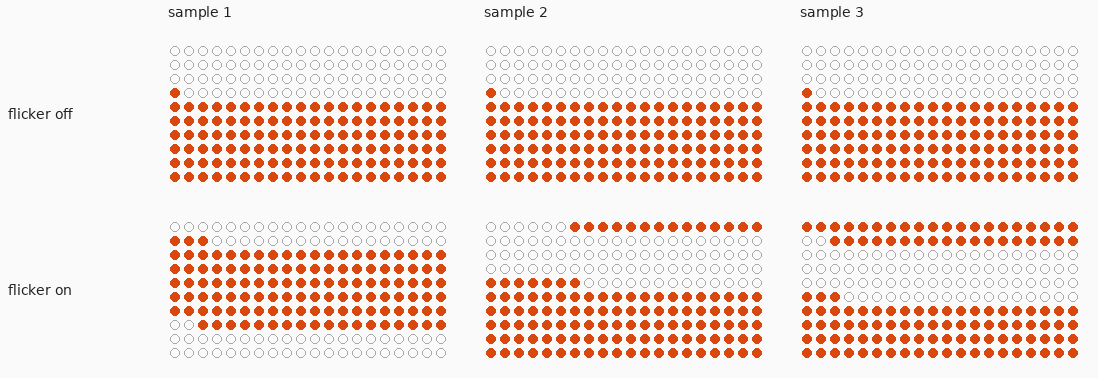
Filled dots are bullets present in OAM, hollow ones are bullets that were not drawn. With flicker off, the same 79 are missing in every sample. With it on, the gap moves.
The method has the limits of an emulator: melonDS and mGBA are not a console, and none of this has been run on hardware. The per-scanline limits were not checked at all.
What is left
The rotation only deals with the whole-OAM limit, the 128 entries. Both consoles also limit how many sprites can be on one scanline, and that limit can be hit by a wide row of bullets before the 128 total is, so it is the next thing to check. Two other items sit next to it in the roadmap: a way to report how many sprites a frame used, so a game can see its budget without a debugger, and a priority for single sprite entities and text, which today are always drawn before every batch.